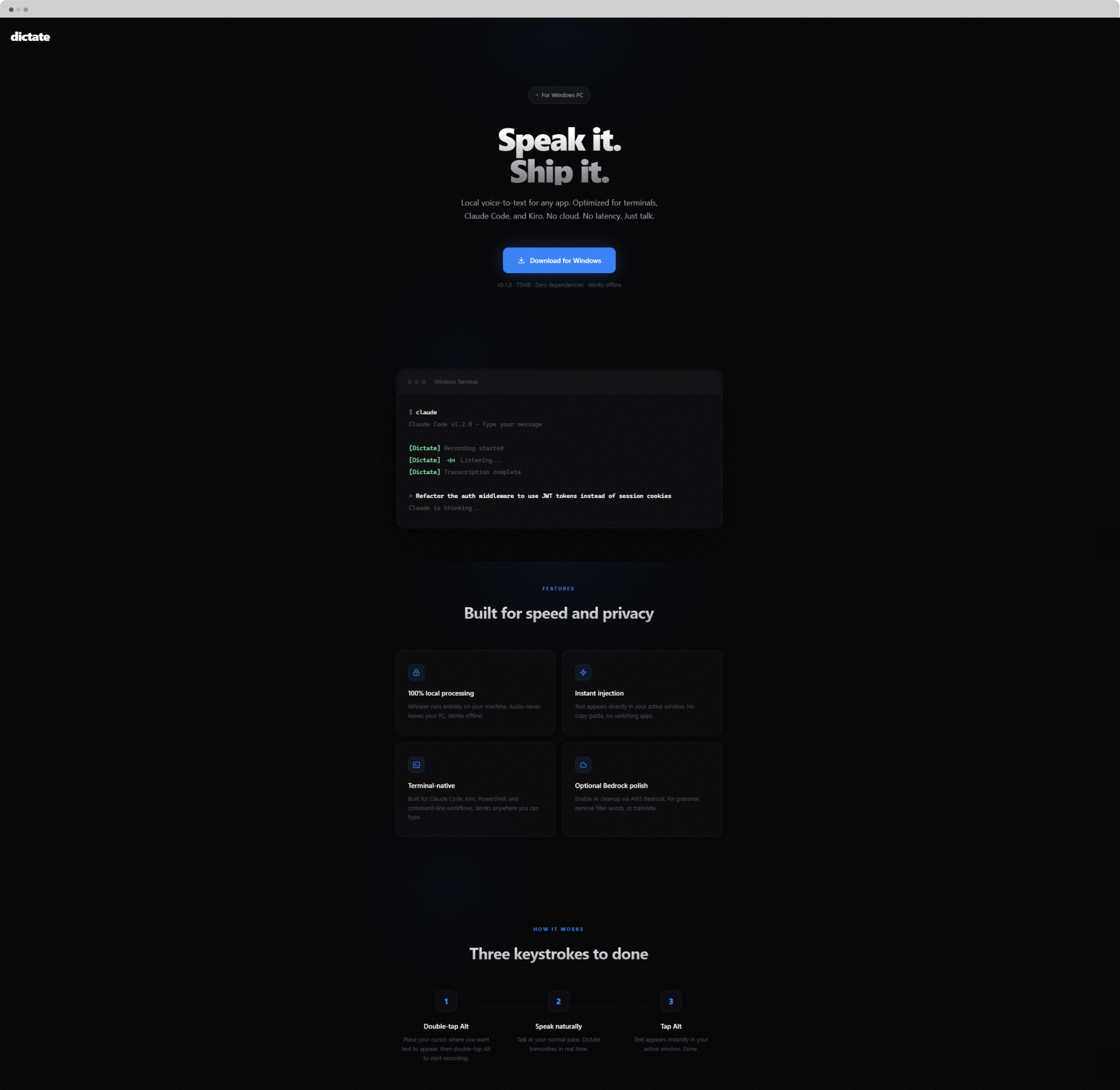
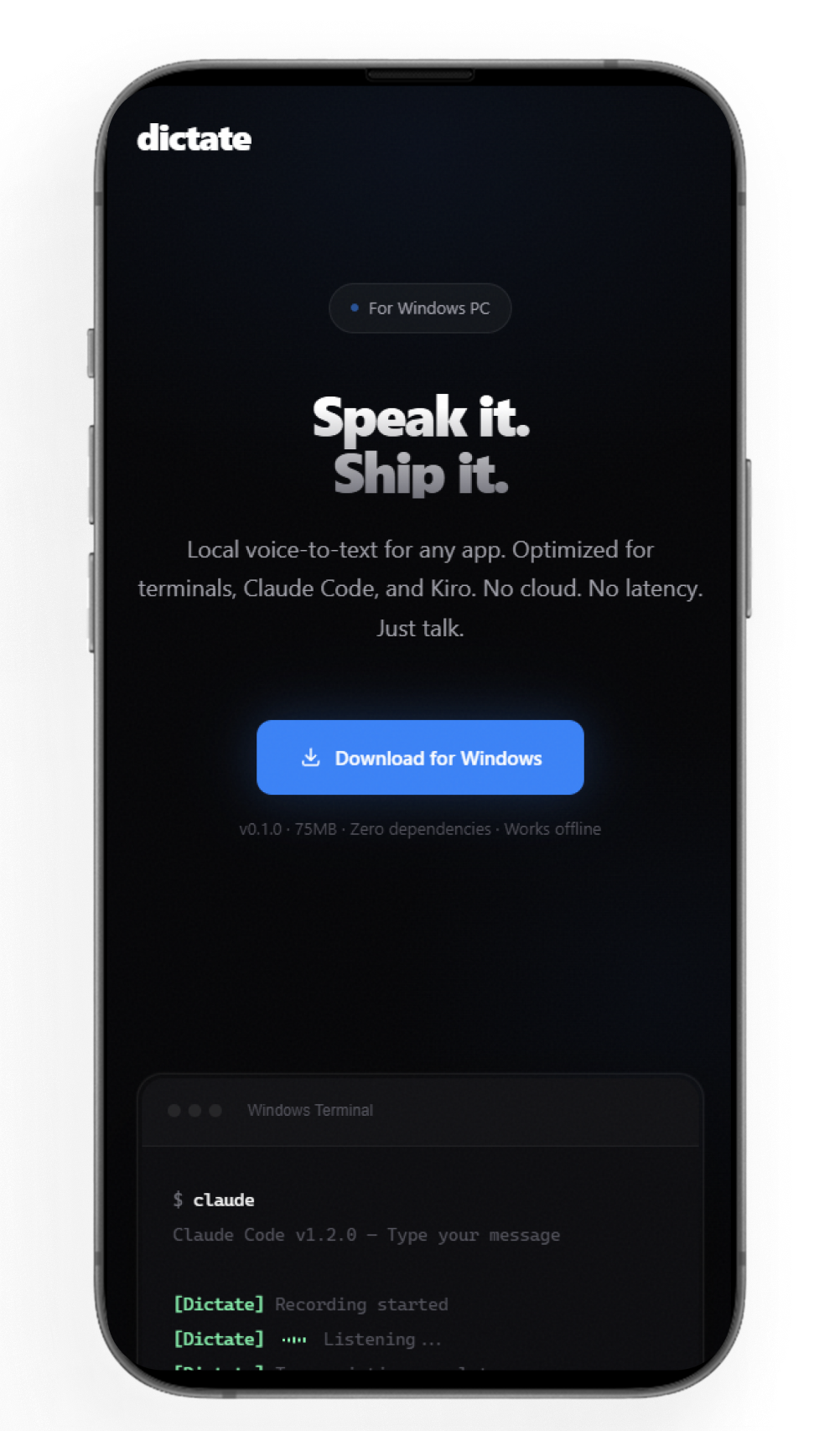
At home, on my personal Mac, I'd gotten used to speaking my prompts to Claude Code instead of typing them. Conversational, paragraph-long instructions are faster to say than to type, and a tool called Wispr Flow made it effortless. Then I'd sit down at my Windows machine at work and that entire workflow vanished. There was no local, PC-native equivalent. So instead of filing it under things I wished existed, I built one.
Dictate lives in the system tray: double-tap Alt to start, tap to stop, and the transcription drops straight into whatever window is in front of you: a terminal, an editor, a chat box. The thing I cared about most is that it all runs on the machine. Audio never leaves the PC; it's transcribed locally. That's the difference between a tool you can actually use for sensitive work and one that's a compliance problem from day one. It ships as a single installer with nothing else to wrangle.
Under the hood, Dictate is a native app written in Rust, talking to low-level Windows APIs and running a local speech model as a subprocess. I didn't write that code. Claude Code did. My job was the product: what it should do, where it should be sharp, what to leave out. The barrier to building real software used to be knowing how. Increasingly, it is knowing what you want and being willing to direct it.